Several major museums have released their public-domain collections as free, high-resolution downloads with no restrictions on commercial use. The Metropolitan Museum of Art, the Cleveland Museum of Art and the Art Institute of Chicago all publish open APIs alongside the images, so the artwork can be searched and fetched without an account.
Where can museum artwork images be downloaded legally?
From the museums themselves, under open-access programmes that place public-domain works under a CC0 dedication or an equivalent no-rights-reserved statement. That is a stronger permission than most stock licences, because it removes the attribution requirement as well as the fee, though crediting the source remains good practice.
The three collections below were queried directly at the time of writing, using each museum’s public API. The counts are what the API returned, not what the marketing pages claim.
| Collection | Scale | Terms |
|---|---|---|
| Metropolitan Museum of Art | 502,322 object records | CC0 for works flagged public domain |
| Cleveland Museum of Art | 42,260 CC0 artworks | CC0, no permission needed |
| Art Institute of Chicago | 132,681 artwork records | Public-domain works unrestricted |
The subset matters. A collection of half a million records does not mean half a million free images, because much of any modern museum’s holdings is still in copyright or was photographed under licence.
How do you tell which works are actually free?
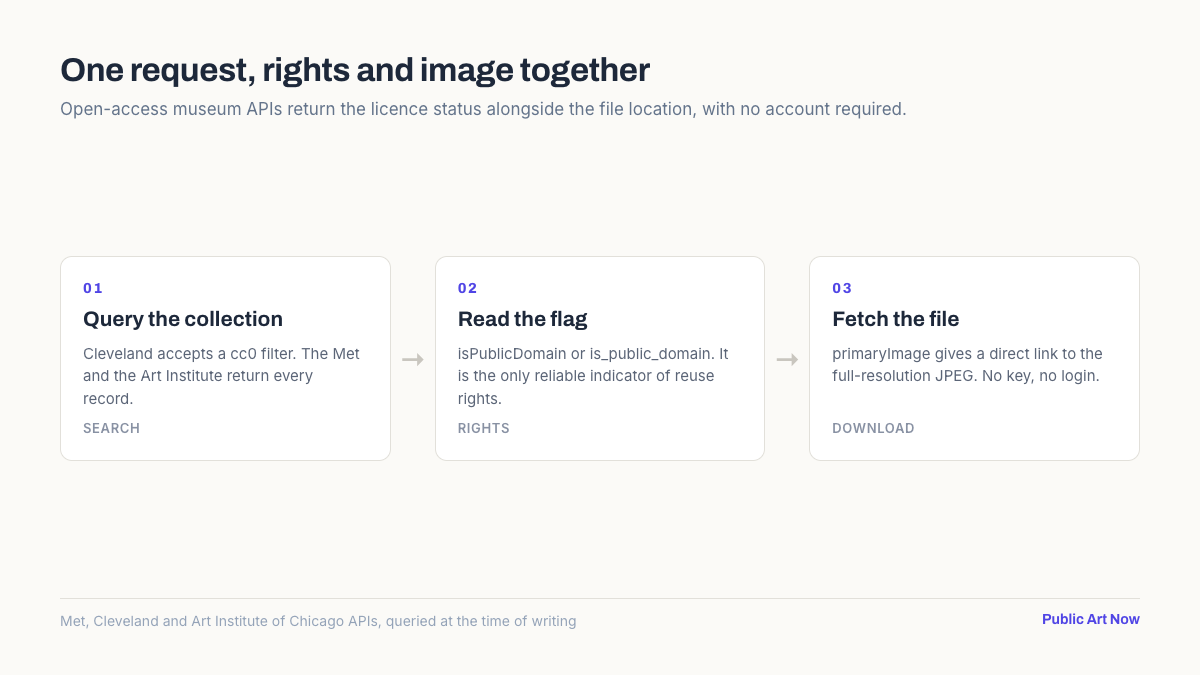
Each API exposes a flag, and it is the only reliable indicator. The Met returns an isPublicDomain boolean on every object; the Art Institute returns is_public_domain; Cleveland accepts a cc0=1 filter that returns only unrestricted works. Ignore the flag and the licence position becomes guesswork.
A worked example makes the pattern clear. Requesting object 436535 from the Met’s API returns Van Gogh’s Wheat Field with Cypresses with isPublicDomain set to true and a direct link to the full-resolution JPEG under primaryImage. No key, no login, no rate-limit negotiation.
Where the flag is false, the record is still useful for research but the image is not free to reuse. That distinction is the whole of the compliance work.
The APIs are also rate-limited generously rather than metered, which makes them practical for building a reference library rather than pulling one image at a time. Cleveland’s endpoint returns full records including the licence status in a single call, so a filtered list of a few thousand usable works takes minutes rather than an afternoon.
Why are museums giving this away?
Because charging for reproduction rights was never profitable and was actively harmful to their mission. Image licensing departments cost more to run than they earned at most institutions, while the permissions process discouraged exactly the scholarly and educational use museums exist to encourage.
The Met opened its collection in February 2017 and others followed quickly. The results were measurable in reach rather than revenue: open images propagate into Wikipedia, teaching materials, design work and research in a way gated ones never do.
The permissions desk was a toll booth on a road nobody was driving down. Removing it cost almost nothing and multiplied the traffic.
There is a legal argument underneath it too. A faithful photographic reproduction of a two-dimensional public-domain painting attracts no new copyright in several jurisdictions, the position taken in Bridgeman Art Library v. Corel in the United States, so much of what museums were licensing may not have been theirs to license.
That reasoning does not extend to photographs of sculpture or objects, where the photographer makes genuine creative choices about lighting and angle. It is one reason open-access programmes cover paintings and prints far more comprehensively than three-dimensional holdings.
Which other collections are worth knowing?
Several, and they differ in what they hold rather than in generosity. A European painting is likely to be better served by Amsterdam or Washington than by an American encyclopedic museum, and photography and design sit in different places again.
- Rijksmuseum. Dutch Golden Age painting at very high resolution, with an API and a long-standing open policy.
- National Gallery of Art. Open access to images of works believed to be in the public domain.
- Smithsonian Open Access. Millions of CC0 items spanning art, science and history collections.
- Getty Open Content. Paintings, drawings, manuscripts, photographs and antiquities at full resolution.
Aggregators such as Europeana and Wikimedia Commons search across many institutions at once, which is faster for finding a specific work but less reliable on rights status, because the metadata quality varies by contributor.
What still needs checking before publishing?
Two things that CC0 does not cover. The dedication addresses the museum’s own rights in the image; it says nothing about rights held by third parties in what the image depicts, and nothing about trademark or personality rights that survive copyright expiry.
The practical cases are narrow but real. A photograph of a modern sculpture in a museum’s collection may be public domain as a photograph while the sculpture itself remains in copyright, and identifiable living people in documentary photographs carry their own considerations.
The rule of thumb that resolves most of it: works by artists who died more than seventy years ago are safe everywhere, and the museums’ public-domain flags are reliable for exactly that category. Anything twentieth-century deserves a second look, for the same reason that photographing recent public artworks is more complicated than it appears.
The bottom line
Hundreds of thousands of high-resolution artwork images are free to download and reuse commercially, published by the museums that hold the originals. The Met, Cleveland and the Art Institute of Chicago all expose them through open APIs with an explicit public-domain flag on every record.
For anyone building a site or a publication around historical images, this is a better starting point than any stock library, and it pairs well with the generative tools for the cases where no historical work fits. Check the flag rather than assuming, prefer the museum’s own copy over an aggregator’s, and treat anything made in the last century as needing a second look. Everything else is genuinely free.
Frequently asked questions
Can museum images be used commercially?
Yes, where the museum has released them under CC0 or an equivalent open-access policy. The Met, Cleveland Museum of Art, Art Institute of Chicago, Rijksmuseum and Smithsonian all permit commercial reuse of works flagged as public domain.
Do you have to credit the museum?
Not legally, under a CC0 dedication, which waives attribution along with other rights. Crediting the institution and the artist remains normal practice and costs nothing, and some museums request it without making it a condition.
How do you find the high-resolution file?
Through the museum’s API. The Met returns a direct JPEG URL in the primaryImage field of each object record, and the Art Institute and Cleveland expose equivalent image endpoints, all without requiring an account or an API key.
Is every work in these collections free?
No. Only the subset flagged as public domain. The Met’s API lists over 500,000 object records but the open-access permission applies only where isPublicDomain returns true, and the same pattern holds at the other institutions.
Are these better than stock photo sites?
For historical artwork, considerably. The files are photographed to archival standards at resolutions stock libraries rarely match, the rights position is unambiguous, and there is no licence to renew or seat count to track.