Generating a listenable track is no longer the difficult part of AI music. Releasing it is. Every tool in this category attaches conditions to its output, and those conditions differ so sharply that two tracks of identical quality can have completely different legal futures. One can be sold; the other cannot legally appear on a monetised video. The licence, not the audio, is the thing worth comparing.
Why does the licence matter more than the sound?
Because music is almost never made for its own sake. It goes into a video, a podcast, a game, a shop, or an advertisement, and every one of those is a use the licence either permits or forbids. A track that cannot be used commercially is not a cheaper track. It is a different product entirely.
The trap is that nothing about the file tells you which one you have. There is no watermark, no metadata, and no warning at the point of download. The restriction lives in a terms page, and it only becomes visible when a platform issues a claim or a client asks for proof of rights.
Nothing about the audio file tells you whether you are allowed to release it. That information lives on a page you did not read.
What each free option actually permits
Suno, generous with songs, strict with rights
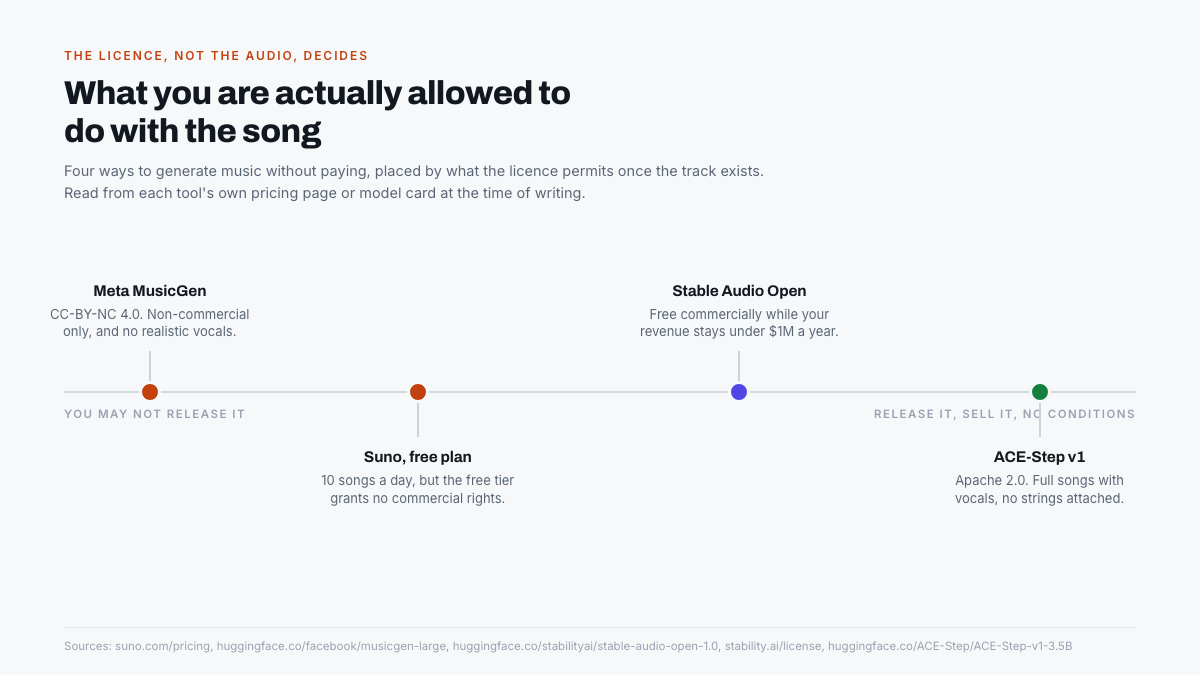
Suno has the most usable free allowance in the category. Its pricing page gives free accounts 50 credits renewing daily, which it puts at ten songs a day. For learning the tool, testing ideas, or making something for a friend, that is more than enough.
The same page is equally clear about the catch. The free plan is listed as no commercial use, while both paid tiers grant commercial rights for new songs made. Ten free songs a day is a real allowance, but everything produced under it is personal-use output. Anyone planning to put the result behind an advertisement, a paid product, or a client invoice needs the paid tier, and the rights attach to songs made while subscribed rather than retroactively.
Meta MusicGen, open weights with a closed door
MusicGen is frequently recommended as the free, open, run-it-yourself answer, and the first half of that is true. The weights are downloadable and the large checkpoint runs 3.3 billion parameters. The second half is wrong in a way that matters.
The model card releases the weights under CC-BY-NC 4.0. The NC is non-commercial: attribution is required and commercial use is prohibited outright. Running a model locally does not change what its licence allows. There is also a practical limit worth knowing before investing time, since the same card states the model cannot generate realistic vocals, so it produces instrumental music only.
Stable Audio Open, free until you succeed
Stability’s approach is the most pragmatic of the four. Stable Audio Open 1.0 ships under the Stability AI Community License, and the licence page sets a clear threshold: use is free for everyone unless the organisation using it commercially generates over $1M in annual revenue, regardless of the source of that revenue. Above that line, an enterprise licence is required.
For almost every individual creator and small studio, that is effectively unrestricted commercial use. The technical fit is narrower than the licence, though. Its model card describes variable-length stereo audio up to 47 seconds at 44.1kHz, notes it cannot generate realistic vocals, and states it is better at sound effects and field recordings than at music. Treat it as a sound-design tool that also does short instrumental beds, not as a song generator.
ACE-Step, the one with no conditions
ACE-Step is the only option here that produces full songs with vocals and attaches no commercial restriction at all. Its model card lists the 3.5B model under Apache 2.0, with full-song generation and duration control, and reports generating four minutes of music in about 20 seconds on an A100.
It also runs on ordinary hardware, reporting a real-time factor of 34.48 on an RTX 4090 and 2.27 on an M2 Max, so a laptop generates faster than playback. The honesty of the card is its best feature: it describes the vocal synthesis as coarse and lacking nuance, warns that generations beyond five minutes lose structural coherence, and admits results are highly sensitive to the random seed. Expect to generate several and keep one.
Quick comparison
| Tool | Free allowance | Commercial use | Vocals |
|---|---|---|---|
| Suno | 50 credits daily, about 10 songs | No, paid plans only | Yes |
| Meta MusicGen | Unlimited, run locally | No, CC-BY-NC 4.0 | No |
| Stable Audio Open 1.0 | Unlimited, run locally, up to 47s | Yes, under $1M annual revenue | No |
| ACE-Step v1 3.5B | Unlimited, run locally | Yes, Apache 2.0 | Yes, but coarse |
How to pick without reading four terms pages
Work backwards from where the track ends up. The destination settles the choice faster than any comparison of audio quality, because the legal requirement is binary and the quality difference is a matter of taste.
- Nothing leaves your computer. Anything works, including MusicGen. Non-commercial licences are only a problem when the output is published.
- A monetised video or podcast. ACE-Step, or Suno on a paid plan. A monetised upload is commercial use even when the music is incidental.
- Client work. ACE-Step under Apache 2.0 is the cleanest answer, because you can hand over the rights without conditions attached to your own revenue.
- Sound effects, stings, ambience. Stable Audio Open, which is built for exactly this and cleared for commercial use below the revenue threshold.
- A song with real vocals that must sound finished. Suno on a paid plan. Nothing free currently matches it for vocal quality.
The parts nobody puts on the pricing page
Two issues sit outside the licence and apply regardless of which tool produced the track. The first is training data. Several of these systems were trained on catalogues whose status is contested, and litigation in this area is ongoing. A licence grants what the vendor is able to grant; it is not a guarantee against a third-party claim.
The second is platform policy, which is a separate layer from copyright. Distributors and streaming services set their own rules on AI-generated material, including disclosure requirements and, in some cases, refusal. A track can be entirely legal to release and still be rejected by the service you wanted to release it on. Check the destination’s policy before the licence becomes the bottleneck.
The bottom line
ACE-Step is the sensible default for anyone who wants free music they can actually use, because Apache 2.0 removes the question entirely and it is the only free option producing full songs with vocals. Stable Audio Open is the better tool for sound design, with a revenue threshold most people will never reach.
Suno remains the best-sounding option and the most expensive to use properly, since its free tier is a rehearsal room rather than a studio. MusicGen is worth knowing about and, for anything published, worth avoiding. Check the licence before the first generation, not after the track is finished and already in a timeline.
Frequently asked questions
Can I use Suno’s free plan for YouTube videos?
Not if the channel is monetised. Suno’s pricing page lists the free plan as no commercial use, and grants commercial rights only on its paid tiers. A monetised upload counts as commercial use even when the music is only background.
Is MusicGen free for commercial use?
No. The MusicGen weights are released under CC-BY-NC 4.0, where NC means non-commercial. Downloading the model and running it on your own hardware does not change that restriction, and the model cannot generate realistic vocals either.
Which free AI music generator allows commercial use?
ACE-Step v1 is the cleanest, shipping under Apache 2.0 with no conditions. Stable Audio Open also permits commercial use free of charge, provided the organisation using it generates under $1M in annual revenue.
Do I own the songs an AI generates?
What you get is a licence to use the output, and its scope varies by tool. Open-weight models under Apache 2.0 place no conditions on the result. Hosted services typically reserve commercial rights for paying subscribers, so ownership is better understood as permission than as property.
Can AI music be uploaded to Spotify and other streaming services?
Platform policy is separate from the licence. Distributors and streaming services set their own rules on AI-generated material, including disclosure requirements and outright refusal in some cases. Confirm the destination’s current policy before assuming a legally clear track is publishable there.