Social platforms do not look at a photograph and judge whether it looks artificial. They read a signed record inside the file that states what made it. That is why a lightly retouched holiday snap can be labelled as AI-made while a fully generated image, re-saved as a screenshot, sails through untouched.
How does a platform know an image is AI-generated?
Mostly by reading metadata written by the tool that created it. Meta’s own account of its labelling policy says it adds a label “when we detect industry standard AI image indicators or when people disclose that they’re uploading AI-generated content”. The detection is a metadata lookup first, and a visual judgement only as a fallback.
That design choice explains almost every complaint about the labels. A file carrying the indicator gets flagged regardless of how much of it was actually generated. A file without one does not, however synthetic it looks.
The generative editing features now built into mainstream photo software are what make this a mass-market problem rather than a niche one. Meta announced the approach in early 2024, began applying labels in May of that year, and renamed the badge from “Made with AI” to “AI info” on 1 July 2024 after photographers objected that minor edits were triggering it. In September 2024 the label for content only edited by AI tools was moved off the image and into the post menu.
What is the signal the platforms are reading?
Chiefly Content Credentials, the public name for a manifest defined by the C2PA specification. The specification describes it as provenance information built from “one or more assertions (including content bindings), a single claim, and a claim signature”, or in plain terms, a signed statement about what made the file and what has edited it since.
A second, older signal sits alongside it. The IPTC photo metadata standard carries a digital source type field, and generative tools write a value into it declaring the content was produced by an algorithm. It is a single tag rather than a signed document, which makes it easy to write and equally easy to strip.
Some vendors add an invisible watermark in the pixels themselves as a third layer. Google’s SynthID is the best known. That survives re-encoding in a way metadata does not, but it only exists for images from tools that apply it, and each vendor’s watermark is readable mainly by that vendor.
| Signal | Where it lives | Survives a screenshot |
|---|---|---|
| C2PA manifest | Signed metadata block | No |
| IPTC digital source type | Metadata tag | No |
| Invisible watermark | Pixel data | Usually |
| Self-declaration | The upload form | Not applicable |
Why does a real photo get labelled as AI?
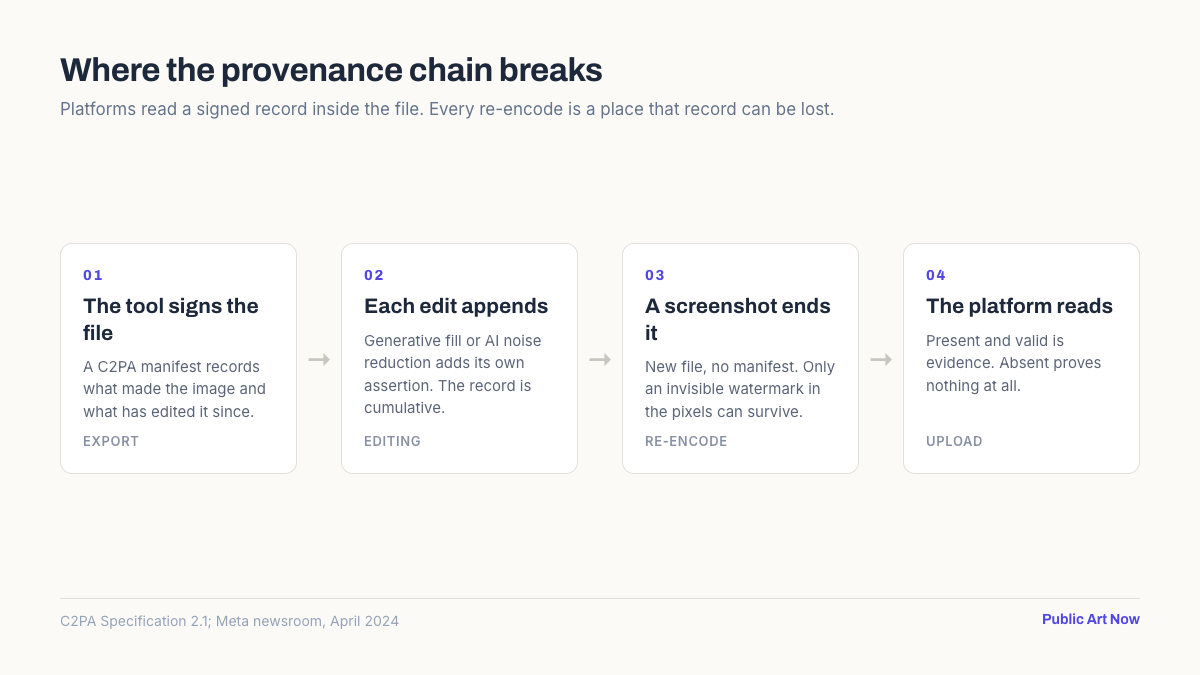
Because the indicator records that a generative tool touched the file, not that the picture is fictional. Editing software increasingly writes a provenance assertion whenever a machine-learning feature is used, and generative fill, sky replacement and AI-based noise reduction all qualify. A one-second cleanup can stamp a photograph for good.
The manifest is cumulative by design. Each tool that handles the file can append its own signed record, so the chain preserves the fact that an AI edit happened even if every trace of it was later painted over.
The label answers a question about the file’s history. Most people read it as a claim about whether the picture is real, and those are not the same question.
Meta’s rename from “Made with AI” to “AI info” was an admission of exactly this gap. The underlying detection did not change; the wording was softened because the original phrasing implied something the signal could not support.
Why does a screenshot defeat the label?
Because a screenshot creates a new file with no history. The C2PA manifest is bound to the asset by a cryptographic hash, and the specification is explicit that an asset “can become separated from its C2PA Manifest due to removal or corruption of asset metadata”. Re-encoding the pixels leaves nothing behind to read.
The specification anticipates this and defines soft bindings, meaning fingerprints and invisible watermarks, which “enable digital content to be matched even if the underlying bits differ”. These can survive a re-encode, but only if the originating tool applied one and the platform checks for it.
The practical result is asymmetric. Provenance is good evidence when it is present and intact. Its absence proves nothing at all, which is the single most important thing to understand about the system.
What can be done about a wrongly labelled photo?
Work upstream rather than fighting the label. The signal is written at export time, so the only reliable fix is to control which tools touch the file and what they record before it is uploaded anywhere.
- Check the file before posting. The Content Credentials verify tool shows exactly what a file declares about itself.
- Avoid generative features for routine work. Manual healing and cloning do not usually write a generative assertion; generative fill does.
- Keep the original. An untouched capture file is the evidence that resolves any dispute about a labelled export.
- Do not strip metadata as a habit. It removes your authorship and copyright fields along with the label, and the platforms may still watermark-match.
The same asymmetry runs through every attempt to identify machine-made media by inspection, which is why the tools that generate these images are far easier to audit at the point of export than after the fact. Stripping provenance is the obvious workaround and the worst one. It is the same act, technically, whether performed by a photographer clearing a false label or by someone disguising a fabricated image, and it degrades the only system currently capable of telling the two apart.
The bottom line
AI labels on social platforms describe the file’s editing history, not the truthfulness of the image. They are triggered by signed metadata written at export, which means honest photographers using ordinary retouching tools get flagged while a re-saved screenshot of a fabricated scene does not.
Anyone publishing work made with free generative video and image tools should assume the provenance record travels with every export, and check it before a client or a platform does. Read the badge as a statement about provenance and it is accurate and useful. Read it as a verdict on whether a picture is real, and it will mislead in both directions.
Frequently asked questions
How does Instagram know an image is AI-generated?
It reads industry-standard indicators written into the file by the tool that made it, chiefly C2PA Content Credentials and IPTC metadata, or it relies on the uploader disclosing it. Visual analysis is a secondary fallback, not the primary method.
Why does my photo say AI info when I only made small edits?
Because editing tools write a provenance assertion whenever a machine-learning feature is used. Generative fill, sky replacement and AI noise reduction all count, and the record persists in the file even after the edit itself is undone.
Does taking a screenshot remove the AI label?
It removes the metadata, because a screenshot produces a new file with no manifest. An invisible watermark embedded in the pixels can still survive, so the outcome depends on which tool made the original image.
Are Content Credentials the same as a watermark?
No. Content Credentials are a signed metadata manifest bound to the file by a cryptographic hash. An invisible watermark is a pattern hidden in the pixel data. The first is tamper-evident but fragile; the second is durable but carries far less information.
Does the absence of an AI label mean an image is genuine?
No. Provenance data is easily removed and many tools never write it, so an unlabelled image tells you nothing. Only a present and valid manifest carries evidential weight, and only about the file’s history.