Ten years ago, projection mapping was a novelty. You saw it at a product launch or a New Year celebration, thought “neat,” and forgot about it by the next morning. Now it is a fixture. City festivals build entire programs around it, museums use it to reinvent collections they have owned for a century, and local councils commission mapped installations the way they once commissioned bronze statues. The interesting question is not whether the technology improved. It obviously did. The interesting question is why cities suddenly want it on every available surface.
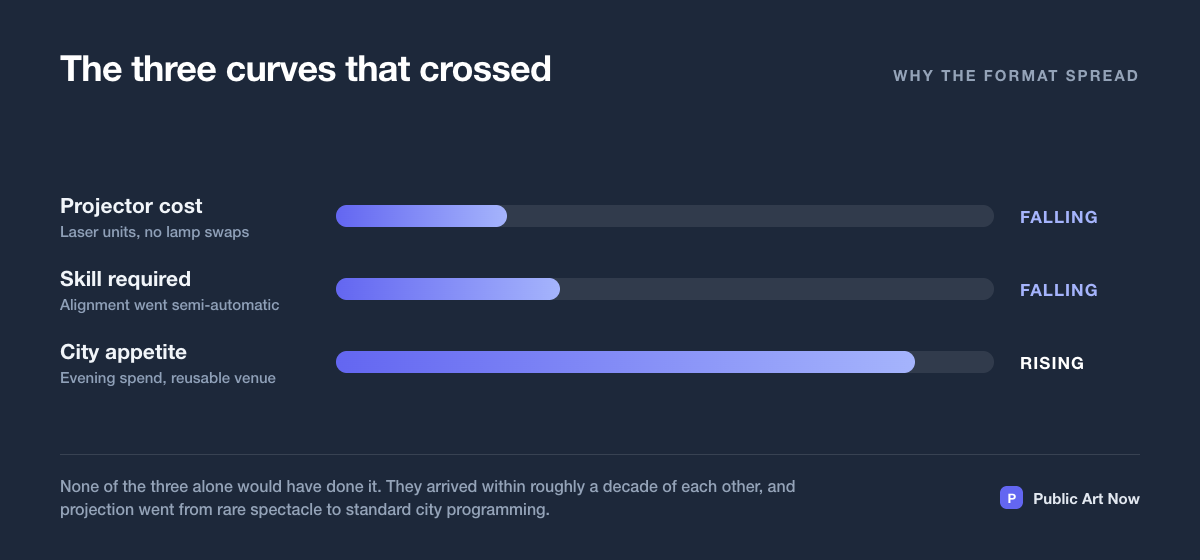
The short answer is that three separate curves crossed at once: hardware got cheap, software got simple, and city governments discovered the economics were unusually good. Pull those apart and the whole shift makes sense.
Why did projection mapping suddenly get affordable?
The biggest change is boring: price. A projector bright enough to cover the facade of a building used to cost as much as a car, and one was never enough. You needed several, positioned carefully and blended together by a specialist team, because a single unit could not throw enough light across a large surface without washing out. The equipment budget alone put mapped installations out of reach for anyone but corporations and national celebrations.
Laser projectors changed that math completely. They run for tens of thousands of hours without the lamp swaps that made older units a maintenance headache, they survive being sealed in weatherproof enclosures outdoors, and a mid-range laser unit now delivers what a flagship did a decade ago. The price of throwing bright, sharp light onto a wall has fallen far enough that a regional arts festival can rent the gear without blinking.
Brightness is the specification that unlocked everything. Early projectors could only work after full dark on modest surfaces. Modern units are bright enough to hold an image on a large facade even with ambient city light bleeding in, which means shows can start earlier, run in more locations, and survive the glow of a real urban environment. That single improvement widened the range of usable venues enormously.
Do you still need a specialist to run it?
Hardware was only half the barrier. Mapping content onto an irregular surface, a building with windows, ledges, and corners, once meant custom tooling and weeks of painstaking calibration. Someone had to manually warp the image so it lined up with every architectural feature, and if the projector moved even slightly, the whole alignment fell apart. This was skilled, slow, expensive work that only a handful of studios could do well.
Modern mapping software collapsed that timeline. Alignment is now semi-automatic: point a camera at the surface, let the software detect the geometry, and it warps the content to fit in minutes rather than days. Templates exist for common surface types, and the tools that once lived only in expensive proprietary suites now have accessible, even free, alternatives. A show that needed a specialist studio and a month of setup in 2015 can be delivered by a two-person team in a week.
That collapse in required skill is what turned projection mapping from a rare specialty into something a mid-sized city’s events team can actually commission and manage. When the barrier to entry drops, the number of people doing the thing explodes. That is exactly what happened here.
Why do cities keep funding projection mapping?
Cheaper gear and simpler software explain how projection became possible. The economics explain why cities actually wanted it. Light festivals turned out to be an unusually good deal for a city government, and once the numbers became clear, the format spread fast.
Compare the options a city has for attracting visitors. A permanent sculpture is a one-time attraction with ongoing maintenance and no reason to visit twice. A concert series needs stages, security, insurance, and headline fees that climb every year. A projection festival, by contrast, reuses the city itself as the venue. The buildings are already standing, the content is digital and can be reused or updated cheaply, and the whole event happens after dark, which pushes visitors into restaurants, bars, and hotels during hours those businesses would otherwise sit empty.
Set the three options side by side and the appeal is obvious.
| What a city can commission | Venue cost | Repeat visits | Ongoing burden |
|---|---|---|---|
| Permanent sculpture | Site works and installation | Low, seen once | Maintenance, and removal if it sours |
| Concert series | Stages, security, insurance | Only with new headliners | Fees climb every year |
| Projection festival | The buildings already stand | High, content changes | Content is digital and reusable |
That after-dark timing is quietly the most valuable part. Daytime attractions compete with everything else a city offers. An evening light festival fills the dead hours, extends the average visitor’s stay, and sends them spending in exactly the venues that struggle midweek. City finance departments notice numbers like that.
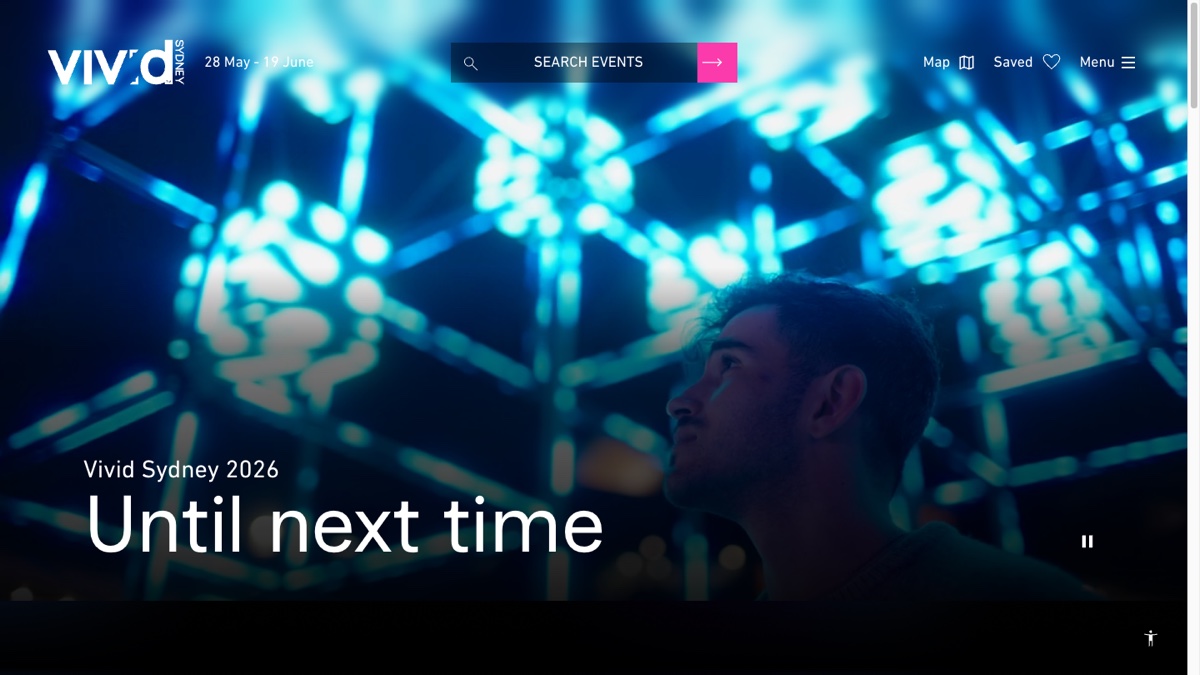
There is also a copycat dynamic. The established festivals are the proof of concept everyone else points at: Lyon’s Fête des Lumières, Vivid Sydney, and the Amsterdam Light Festival each run to a published programme and a visible visitor economy. Once one regional city runs a successful light festival and publishes its visitor figures and hotel occupancy bumps, every neighbouring city wants one too. The events are endlessly photographable, and that is not incidental: a whole category of public art is now designed for the camera first. Attendees flood social media with images, doing the marketing for free and pressuring the next city to keep up. The format spread from a handful of pioneers to hundreds of cities in barely a decade.
What problem does it solve for public art?
Beyond tourism economics, projection solves a genuine headache that has haunted public art forever: permanence. Permanent public art carries permanent risk. Choose badly and a city lives with the decision for decades, along with the arguments, the petitions, and the eventual expensive removal. Every council remembers a statue or mural that became a running embarrassment.
Projection gives cities a way to commission ambitious, even provocative art with an undo button. That single property changes what gets approved.
Projection is reversible by nature. A mapped piece can be experimental, strange, or politically bold, and if it does not land, it is simply gone at the end of the run with nothing to dismantle and no maintenance bill. That reversibility lowers the stakes on every commissioning decision, which means committees approve work they would never dare cast in permanent form. The result is bolder public art, precisely because the risk evaporates at dawn.
It also hands artists a scale they could never otherwise reach. A digital artist with a laptop can occupy an entire cathedral facade for a weekend. No crane, no structural engineering, no permits measured in years, no material costs that balloon with size. The barrier between an individual creator and a monumental canvas has effectively disappeared, and that has pulled a wave of new talent into public work.
What are the fair criticisms of projection mapping?
Not everyone is thrilled, and some of the criticism lands. The most common complaint is that light festivals have become interchangeable. When every city runs one, the shows start to blur into the same swirling abstract visuals projected onto the same kind of historic building. Novelty was part of the original appeal, and novelty does not survive ubiquity.
There is a substance question too. Critics argue that reversibility, the very feature that makes projection attractive, also makes it disposable and shallow compared to art a community lives with and grows attached to over decades. A show that vanishes at dawn asks nothing lasting of anyone. Whether that is a strength or a weakness depends on what you think public art is for, and reasonable people land on opposite sides.
Where does projection mapping go next?
Three shifts are worth watching. First, real-time content: game engines are replacing pre-rendered video, so installations can react to weather, crowd movement, or live data instead of looping the same three minutes forever. That makes each viewing genuinely different and pushes back against the sameness critique.
Second, permanence is creeping back in a new form. As projector lifespans stretch and running costs fall, some cities are moving from annual festivals to year-round mapped landmarks, turning a facade into a permanent but endlessly updatable canvas. Third, generative content: AI tooling is dropping production costs again, which will let smaller towns afford shows that once belonged only to capital cities.
The pattern is familiar from every other creative technology. Costs fall, tools simplify, and something that was once rare spectacle becomes ordinary infrastructure. Projection mapping is simply the first art form whose gallery is the city itself, and that is why, once it became affordable, it appeared everywhere at once.
Frequently asked questions
What is projection mapping?
Projection mapping is the practice of projecting video onto an irregular surface, usually a building, so the image lines up with the surface’s real geometry. Windows, ledges, and corners become part of the artwork rather than distortions in it.
Why do cities prefer it to permanent public art?
Because it is reversible and it reuses buildings that already exist. A mapped piece can be bold or experimental and simply end at dawn, with nothing to dismantle and no maintenance bill, which lowers the risk on every commissioning decision.
Does projection mapping still need a specialist team?
Far less than it used to. Alignment is now semi-automatic in most mapping software, so a job that once took a specialist studio weeks can be delivered by a small team in days. Complex, large-scale shows still benefit from experienced operators.
What is the main criticism of light festivals?
Sameness. When every city runs one, the shows converge on similar abstract visuals projected onto similar historic buildings, and the novelty that drove the original appeal wears off. Critics also argue that work vanishing at dawn asks nothing lasting of a community.