Photographing a public sculpture and publishing that photograph are two different acts, and only the second is regulated. Around half of all countries carry a copyright exception that permits it. The United States is not one of them for sculpture, which surprises most people, because it explicitly permits the same thing for buildings.
What is freedom of panorama?
It is a copyright exception allowing photographs of works permanently placed in public spaces to be published without the artist’s permission. Freedom of panorama is the standard term for it. Wikimedia Commons, which has to track this rule across every jurisdiction it hosts images from, records that “in about half of all countries there is an exception in copyright law which eliminates the need for a license”.
The exception exists because the alternative is unworkable. Without it, a street photograph containing a modern sculpture would need clearance from that sculptor before publication, and a city skyline would need clearance from dozens of architects.
Where it does not exist, the artwork’s copyright applies to the photograph in the ordinary way. The camera does not create a new right; it creates a derivative work that still contains someone else’s protected expression.
Where is it legal to publish a photo of a sculpture?
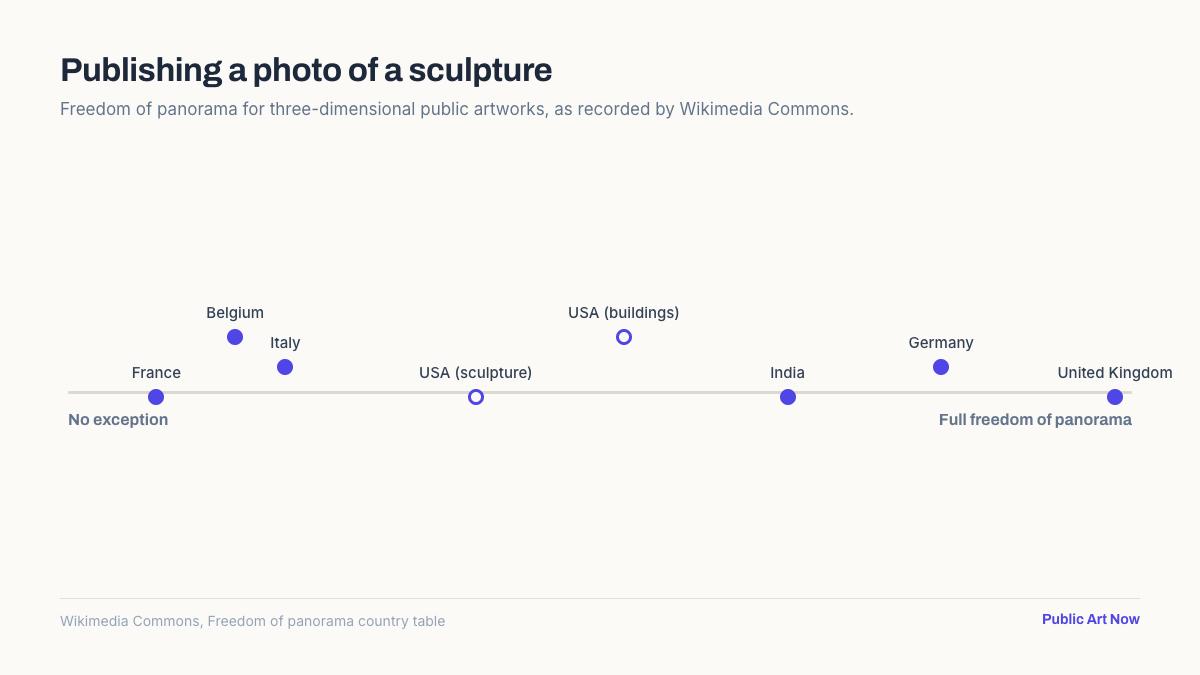
In most of the English-speaking world and much of central Europe. The Wikimedia Commons country table records full freedom of panorama for three-dimensional works in the United Kingdom, Germany, Spain, Austria, Poland, Switzerland, Australia, India, Canada, New Zealand, Singapore, Brazil and Mexico, among others.
The refusals are concentrated in a different group. France, Italy, Belgium, Greece, Romania, Bulgaria, Croatia, Slovenia, Estonia, Latvia and Lithuania are all recorded as having no such exception for three-dimensional artwork.
| Country | Buildings | Sculpture and 3D artwork |
|---|---|---|
| United Kingdom | Permitted | Permitted |
| Germany | Permitted | Permitted |
| India | Permitted | Permitted |
| United States | Permitted | Not permitted |
| France | Restricted | Not permitted |
| Italy | Restricted | Not permitted |
The jurisdiction that matters is the location of the artwork, and often also the country where the image is published. A British photographer posting a French sculpture to a British website has not escaped French law by leaving the country.
Why does the United States allow buildings but not sculpture?
Because the exception was written narrowly and only ever covered architecture. Section 120(a) of the US Copyright Act exempts “pictures, paintings, photographs, or other pictorial representations” of a copyrighted building located in a public place. Nothing equivalent was enacted for sculpture, murals or installations.
The consequence is that any publication of an image of a copyrighted American artwork is, in principle, subject to the approval of the copyright holder. In practice this is rarely enforced against ordinary photographs, but it has been enforced, and commercial use is where claims appear.
American law protects the right to photograph a skyscraper and not the right to photograph the sculpture in its lobby. That gap is an accident of drafting, not a considered policy about art.
Does it matter whether the photo is commercial?
Very often, yes. Several jurisdictions grant the exception only for personal, editorial or documentary use, and withdraw it the moment the image is sold, licensed as stock or used in advertising. The same photograph can therefore be lawful on a personal blog and unlawful on a product.
This is the trap for anyone selling prints or uploading to stock libraries. Agencies routinely reject images containing recent public artworks for exactly this reason, and their rejection notes are usually the first time a photographer learns the rule exists. Getty’s contributor terms place the clearance obligation on the contributor rather than the agency.
The other common limit concerns vantage point. The exception generally covers what is visible from a place the public can normally stand. Photographs taken from a drone, a private balcony or a closed area often fall outside it, even in countries with an otherwise generous rule.
What about murals, street art and temporary works?
Murals are copyrighted artworks like any other, and street art is no exception simply because it was painted without permission. In the United States they may also carry moral rights under the Visual Artists Rights Act, which covers works of recognised stature. Several muralists have brought successful claims over advertising and fashion campaigns shot against their work, and unauthorised placement has not defeated those claims.
- Permanence matters. Most exceptions apply only to works permanently sited. A festival installation or a temporary projection usually falls outside them.
- Incidental inclusion is treated separately. A mural glimpsed in the background of a street scene is a different question from a mural that is the subject of the shot.
- Age settles most of it. Once the artist’s copyright has expired the question disappears, and the term in most countries runs to 70 years after the artist’s death.
- Property rules are separate. A site may forbid photography by contract even where copyright law permits publication, which is how many public sites regulate commercial shoots.
Temporary works are the most exposed category, and also the most photographed. A light festival or a projection piece is designed to be captured and shared, yet the permanence requirement means the exception frequently does not reach it.
What should a photographer actually do?
Establish two facts before publishing: where the work stands, and roughly when the artist died or the work was made. Those two answers resolve the majority of cases without any further research, because most public art in a typical city frame is either old enough or in a permissive country.
The country-by-country copyright summaries on Wikimedia Commons are the most practical free reference for checking a specific jurisdiction, because they are maintained by people who have to apply the rule daily. Where the work is recent and the location restrictive, the practical options are to seek permission from the artist or their estate, to compose the shot so the work is genuinely incidental, or to keep the image out of commercial use. Many artists say yes when asked directly, particularly for editorial work.
The same permanence question decides how projection pieces and light festivals can be shared, and it is usually resolved against the photographer. The wider point is that public art has become optimised for photographs, and the law has not kept pace with the fact that the camera is now the real audience for most of it.
The bottom line
Taking the photograph is almost never the problem. Publishing it can be, and the answer depends on the country the artwork stands in rather than on the photographer’s own. Roughly half of the world’s copyright systems permit it and half do not, with no obvious pattern to the split.
For anyone selling images, the useful habit is to check the location rule once per country rather than once per photograph, and to treat recent sculpture in restrictive jurisdictions as requiring permission by default.
Frequently asked questions
Is it legal to photograph a public sculpture?
Taking the photograph is generally lawful from a public place. Publishing it depends on whether the country where the sculpture stands has a freedom of panorama exception. About half do, including the UK, Germany, India and Australia.
Can you sell a photo of a public artwork?
Only where the local exception covers commercial use, which several countries limit or exclude. Stock agencies commonly reject images featuring recent public artworks because the licensing risk sits with them as well as the photographer.
Does the United States have freedom of panorama?
For buildings only. Section 120(a) of the Copyright Act permits pictorial representations of copyrighted buildings in public places. There is no equivalent provision for sculpture, murals or installations, so those remain subject to the copyright holder’s permission.
Does it apply to murals and street art?
Yes, and unauthorised placement does not remove the artist’s copyright. Murals have supported successful infringement claims against advertising campaigns photographed in front of them, so treat them as protected artworks rather than as scenery.
What about drone photographs?
They often fall outside the exception. Most freedom of panorama provisions cover the view available from places the public can ordinarily reach, so an aerial perspective may not qualify even in an otherwise permissive country.