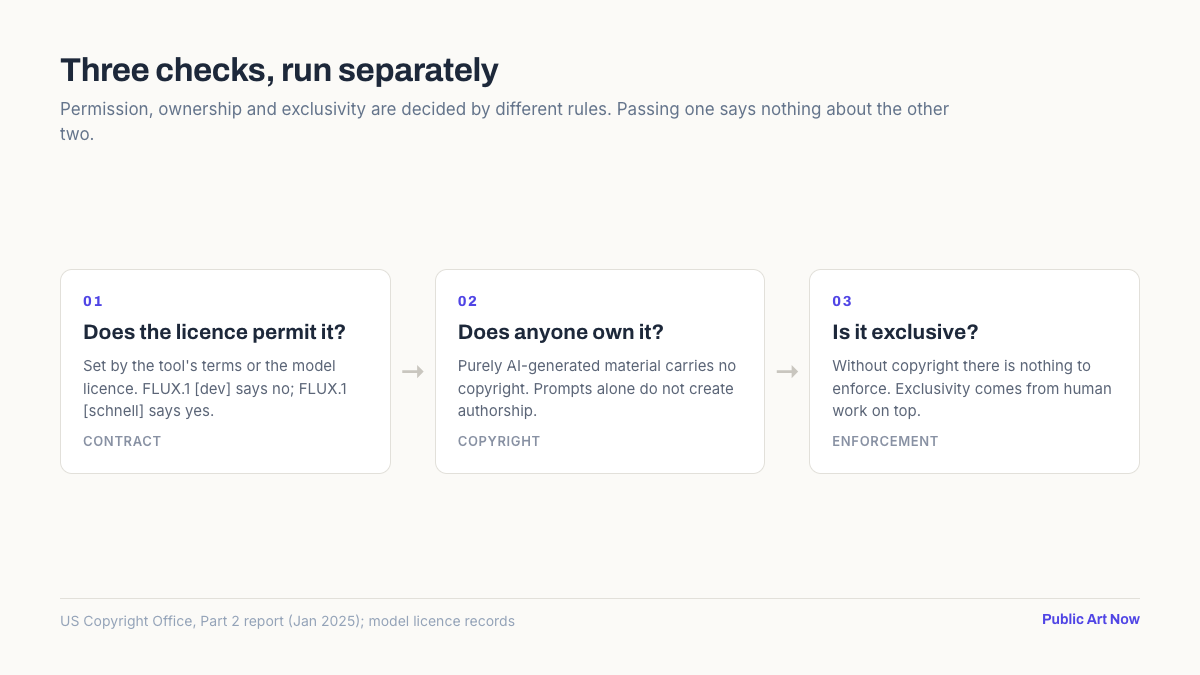
Selling an AI-generated image is usually allowed, but “allowed” and “owned” are not the same thing. Three separate questions decide what can be done with the file: whether the tool’s licence permits commercial use, whether anyone holds copyright in the result, and whether the image is exclusive. Only the first has a clear answer, and it varies sharply between tools.
Can you sell AI-generated images at all?
In most cases yes. The generator’s terms of service, or the model’s licence, decide whether output may be used commercially, and the majority of the free AI image tools worth using permit it. That permission comes from a contract with the vendor, not from copyright law, and it can be withdrawn or narrowed when the terms are revised.
The confusion starts because people read that permission as ownership. It is not. A licence saying output may be used for any lawful purpose settles what the vendor will object to. It says nothing about what a court would enforce against a third party who copies the same image.
Open-weight models make the distinction unmissable, because their licences are published in full and differ from one release to the next.
Who owns an AI-generated image?
Nobody, where the image is purely machine-generated. The US Copyright Office concluded in Part 2 of its report on copyright and artificial intelligence, published January 2025 as part of its AI initiative, that “copyright does not extend to purely AI-generated material, or material where there is insufficient human control over the expressive elements.”
The report is blunt about prompting. Its conclusions state that “based on the functioning of current generally available technology, prompts do not alone provide sufficient control.” Writing a long, detailed prompt does not convert the output into an authored work.
What does survive is the human contribution around the output. The same conclusions confirm that authors keep copyright in “the creative selection, coordination, or arrangement of material in the outputs, or creative modifications of the outputs”. Compositing, painting over, retouching and arranging generated elements into a larger work all count. The generated raster on its own does not.
The Office also declined to recommend any change in the law, saying questions of copyrightability and AI “can be resolved pursuant to existing law, without the need for legislative change”. This position is unlikely to move soon.
What does the tool’s licence actually permit?
It depends entirely on the release, and the difference between two versions of the same model can be the difference between a legal product and an infringing one. The clearest example is Black Forest Labs’ FLUX family, where two sibling models carry opposite terms.
| Model | Licence | Commercial output |
|---|---|---|
| FLUX.1 [schnell] | Apache 2.0 | Permitted |
| FLUX.1 [dev] | FLUX.1 dev non-commercial licence | Not permitted |
| Stable Diffusion XL 1.0 | OpenRAIL++-M | Permitted, with use restrictions |
| Qwen-Image | Apache 2.0 | Permitted |
FLUX.1 [dev] is the version most local image workflows default to, because it produces better results than the fast one. Its licence is explicitly non-commercial. A great many products, thumbnails and client deliverables have been built on it by people who assumed the whole family was open.
Hosted tools rarely publish a licence identifier like this. Their terms sit on a policy page that is revised without notice, so the only reliable check is to open the vendor’s current AI terms before a commercial run and read the ownership clause.
Why is exclusivity the part that catches people out?
Because an image with no copyright owner cannot be defended. If a competitor copies a generated logo, product render or book cover, there is no infringement claim to bring over the generated portion. The usual remedies simply are not available.
Similar prompts also produce similar images. Two people working from the same reference and the same model can land on outputs close enough to be mistaken for each other, and neither has standing to object.
Permission to sell and the ability to stop someone else selling the same thing are different rights. Generative tools grant the first and cannot grant the second.
This matters most where the image carries brand weight. A stock illustration on a blog post is low risk. A logo, a character, or packaging art is the opposite, because its whole commercial value rests on nobody else using it.
What if the image resembles a real brand, person or artwork?
The generative licence stops being relevant. Trademark, personality rights and the copyright in existing works apply to the finished image regardless of how it was made, and none of them care that a model produced it.
- Recognisable characters and logos. Still protected. A generated image of one is still an unlicensed use.
- Real people. Likeness and publicity rights apply, and are strong in several US states and much of Europe.
- Existing artworks. A close reproduction of a copyrighted painting or photograph is an infringement in the ordinary way.
- Public sculpture and architecture. Governed by local rules on freedom of panorama, which vary sharply by country.
Vendors are consistent on this point. Their terms permit use of the output; they do not warrant that any particular output is clear of third-party rights. That risk stays with whoever publishes the image.
What should be checked before selling
Four checks cover almost every practical case, and together they take a few minutes. Run them once per tool rather than once per image, and run them again whenever a model version changes, because licences are attached to versions rather than to brands. Most of the trouble people run into comes from skipping the first one.
- Confirm the exact model or product version, not just the brand. FLUX.1 [dev] and FLUX.1 [schnell] are not interchangeable.
- Read the licence or terms page for the words governing commercial use and ownership of output.
- Decide whether the work needs exclusivity. If it does, add enough human authorship that the finished piece is protectable.
- Screen the image for third-party content: brands, faces, characters, recognisable buildings.
The same reasoning applies to generated audio and video, where the licence terms are typically tighter than for images. Anyone working with the free AI video generators should read the output clause before a paid job, because several of them separate the free tier from commercial rights entirely.
The bottom line
Most AI images can be sold. Almost none of them can be owned. For a background illustration that distinction is academic, and the licence check is the only work required. For anything carrying brand weight it is the whole question, because the value of the asset depends on nobody else being free to use it.
For anything that has to remain yours, such as a logo, a character or a cover, the generated file should be treated as raw material rather than as a finished asset. Human work on top of it is what creates something defensible, and the Copyright Office has said as much in writing.
Frequently asked questions
Are AI-generated images copyright free?
Purely AI-generated material carries no copyright in the United States, so in that narrow sense it is free of copyright. That does not make it free of other rights, and it does not mean the tool’s licence permits every commercial use.
Can you use AI images for commercial purposes?
Usually, provided the tool’s licence allows it. The exception that catches people is non-commercial model licences such as the one attached to FLUX.1 [dev], where commercial output is prohibited even though the weights are freely downloadable.
Does a detailed prompt give you copyright in the result?
No. The Copyright Office concluded that with current technology, prompts alone do not provide sufficient control over the expressive elements to constitute authorship. Copyright attaches to human modification, selection or arrangement, not to the instruction.
Can an AI-generated logo be trademarked?
Trademark protection depends on use in commerce and distinctiveness, not on authorship, so a generated mark can in principle be registered. The weakness is copyright: without it, there is no separate claim against someone reproducing the artwork itself.
What happens if two people generate nearly the same image?
Nothing enforceable. Neither party holds copyright in the generated portion, so neither can stop the other using it. Exclusivity has to be created through human authorship on top of the output, or it does not exist.