Last reviewed August 2026
Open-source AI image generation has closed the quality gap with paid services. Models like FLUX.1 and SDXL now match or exceed Midjourney and DALL-E 3 in photorealism and text rendering, while offering unlimited generation at zero marginal cost and full customisation through community-trained checkpoints and ControlNet conditioning.
How did open-source AI image models progress so quickly?
The trajectory from Stable Diffusion 1.4 in August 2022 to FLUX.1 in August 2024 represents one of the fastest quality escalations in software history. Stability AI released SD 1.4 as a 860M-parameter model producing 512×512 images with visible artefacts. Within two years, Black Forest Labs — founded by former Stability AI researchers — shipped FLUX.1 with 12 billion parameters, native 1024×1024 output, and photorealistic coherence that independent blind tests rated above Midjourney v5.2.
The key milestones tell the story clearly. SDXL (July 2023) introduced a dual-encoder architecture and 1024×1024 native resolution. SDXL Turbo (November 2023) cut generation from 50 steps to 1-4 using adversarial diffusion distillation. FLUX.1 (August 2024) introduced a flow-matching architecture with rotary positional embeddings, producing images with correct text, hands, and spatial relationships — the three areas where open-source had consistently failed.
According to Artificial Analysis benchmarks, FLUX.1 [dev] achieves an ELO rating within 30 points of Midjourney v6 on the GenAI Arena leaderboard, while FLUX.1 [pro] exceeds it in prompt adherence tests.
How does the community model ecosystem work?
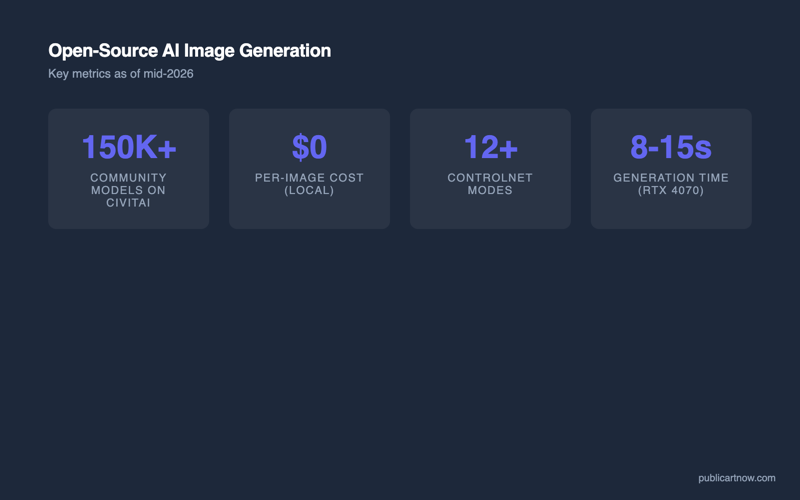
CivitAI hosts over 150,000 community-trained model checkpoints, each fine-tuned for specific domains — architectural visualisation, product photography, anime, medical illustration, fashion. This ecosystem is the structural advantage no commercial service can replicate. A single company trains one general model; a community of specialists trains thousands of domain-specific ones.
The training pipeline democratised rapidly. LoRA (Low-Rank Adaptation) reduced fine-tuning costs from thousands of GPU-hours to under one hour on a single consumer card. A photographer can train a LoRA on 20 images of their studio’s lighting style and apply it to any base model. Midjourney offers style references, but cannot match the precision of a dedicated fine-tune.
Platforms like CivitAI and Hugging Face function as distribution layers. Model creators share checkpoints, training configs, and sample outputs. The result is compounding improvement — each new base model inherits thousands of community refinements within weeks of release.
What role did ControlNet play in closing the gap?
ControlNet, published by Lvmin Zhang in February 2023, solved the precision problem that made open-source impractical for professional work. Before ControlNet, generating a specific composition required dozens or hundreds of re-rolls. ControlNet adds spatial conditioning — edge maps, depth maps, pose skeletons — that constrain the output to match a reference structure.
This single addition turned Stable Diffusion from a creative lottery into a production tool. Architects could feed floor plans and get consistent renders. Product designers could sketch outlines and get photorealistic mockups. Free AI image tools gained capabilities that commercial services still lack — Midjourney has no equivalent to ControlNet’s Canny or Depth preprocessors as of mid-2026.
How do open-source and paid tools compare directly?
| Criteria | FLUX.1 [dev] (Open) | SDXL + ControlNet (Open) | Midjourney v6 | DALL-E 3 |
|---|---|---|---|---|
| Photorealism | Excellent | Very good | Excellent | Good |
| Text in images | Reliable | Unreliable | Moderate | Reliable |
| Spatial control | Via ControlNet | Full (12+ modes) | None | None |
| Custom training | LoRA / full fine-tune | LoRA / DreamBooth | Style references only | Not available |
| Cost per image | Free (local hardware) | Free (local hardware) | ~$0.04-0.06 | ~$0.04 |
| Speed (single image) | 8-15 seconds (RTX 4070) | 4-8 seconds (RTX 4070) | 30-60 seconds | 10-20 seconds |
| Runs offline | Yes | Yes | No | No |
| Commercial licence | Apache 2.0 (dev) | CreativeML Open RAIL-M | Yes (paid plans) | Yes (all plans) |
The real advantage of open-source is not matching commercial quality — it is exceeding it in specialised use cases. A community can train models for specific domains faster than any single company can serve them. An architectural visualisation LoRA trained on 50 images of brutalist concrete achieves results no general model matches, regardless of price tier.
What are the remaining trade-offs?
Open-source demands hardware investment and technical knowledge. Running FLUX.1 [dev] requires at minimum 12 GB of VRAM — an RTX 4070 or equivalent. The setup involves Python environments, ComfyUI or Automatic1111 installation, and model file management. Midjourney requires typing a sentence into Discord.
Paid services maintain advantages in convenience, zero setup, and consistent availability. They also handle content moderation and licensing clarity. For occasional use — a few images per week — the subscription cost remains lower than buying a GPU. For volume work — hundreds of images weekly — local generation pays for hardware within months.
According to Stability AI’s own research blog, the next generation of open models will reduce VRAM requirements further through quantisation and distillation, making the hardware barrier increasingly irrelevant.
For related reading, see why AI models keep shrinking and why open-source AI matters for creatives.
Does open-source AI match Midjourney for portraits?
FLUX.1 produces portraits of comparable quality to Midjourney v6. For specific styles — vintage film grain, studio lighting setups — community LoRA models often exceed Midjourney because they are trained on curated datasets rather than a general corpus.
Is local AI generation truly free?
After the initial hardware investment (an RTX 4070 costs roughly £500-600), every image generated is free. Electricity cost per image is negligible — under £0.001. No subscription, no per-image pricing, no usage caps.
Can beginners use open-source AI tools?
ComfyUI and Automatic1111 have learning curves, but one-click installers now exist for both. Setup takes under 30 minutes on Windows with a compatible GPU. The community documentation on CivitAI is extensive.
Will paid services always exist alongside open-source?
Paid services serve the convenience market — users who want results without managing software. This market persists regardless of open-source quality, just as Photoshop persists alongside GIMP.