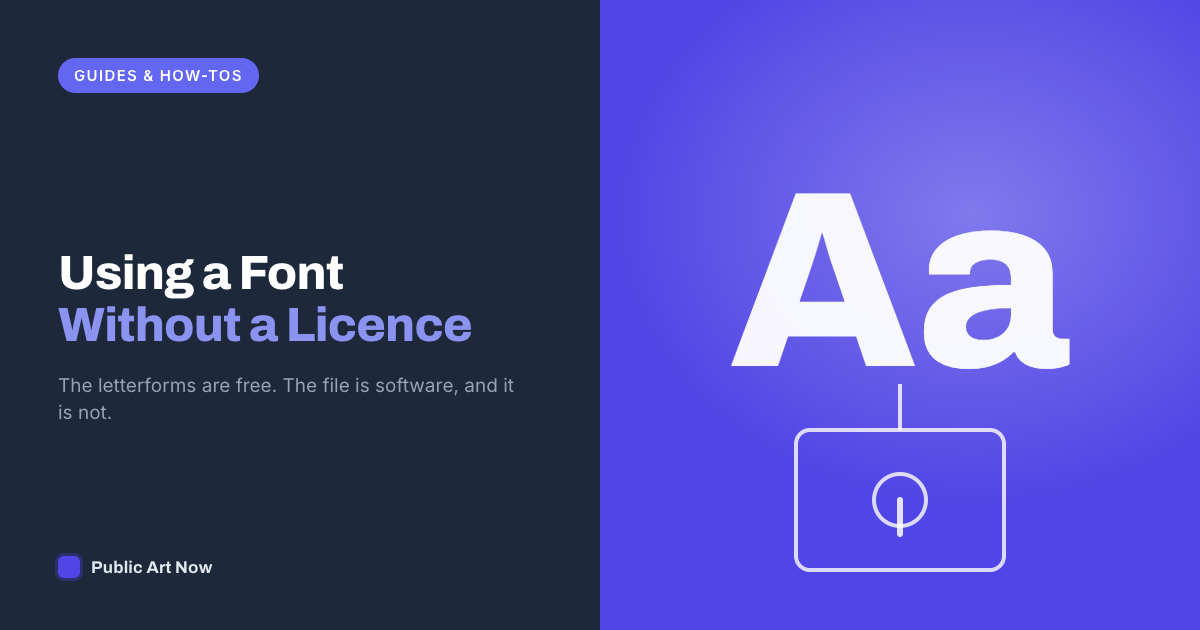
Using a font without a licence is a software infringement, not a design one. In the United States the shapes of the letters are not protected at all, but the file that draws them is, and that distinction decides every case. Statutory damages start at $750 per work and reach $150,000 where the infringement is wilful.
What happens if you use a font without a licence?
The usual sequence begins with a demand letter rather than a lawsuit. Foundries and their agents monitor published work, identify the typeface, and write asking for proof of licence or payment for a retroactive one. Most matters end there, at a cost of a few hundred to a few thousand pounds.
Ignoring the letter is what escalates it. Copyright infringement claims over font software are heard in federal court in the United States, and the damages available do not depend on proving lost sales.
Under 17 U.S.C. § 504(c) a copyright owner may elect statutory damages of “not less than $750 or more than $30,000” per work. Where infringement is wilful the court may increase that “to a sum of not more than $150,000”, and an innocent infringer may see it reduced to $200.
Is a typeface even copyrightable?
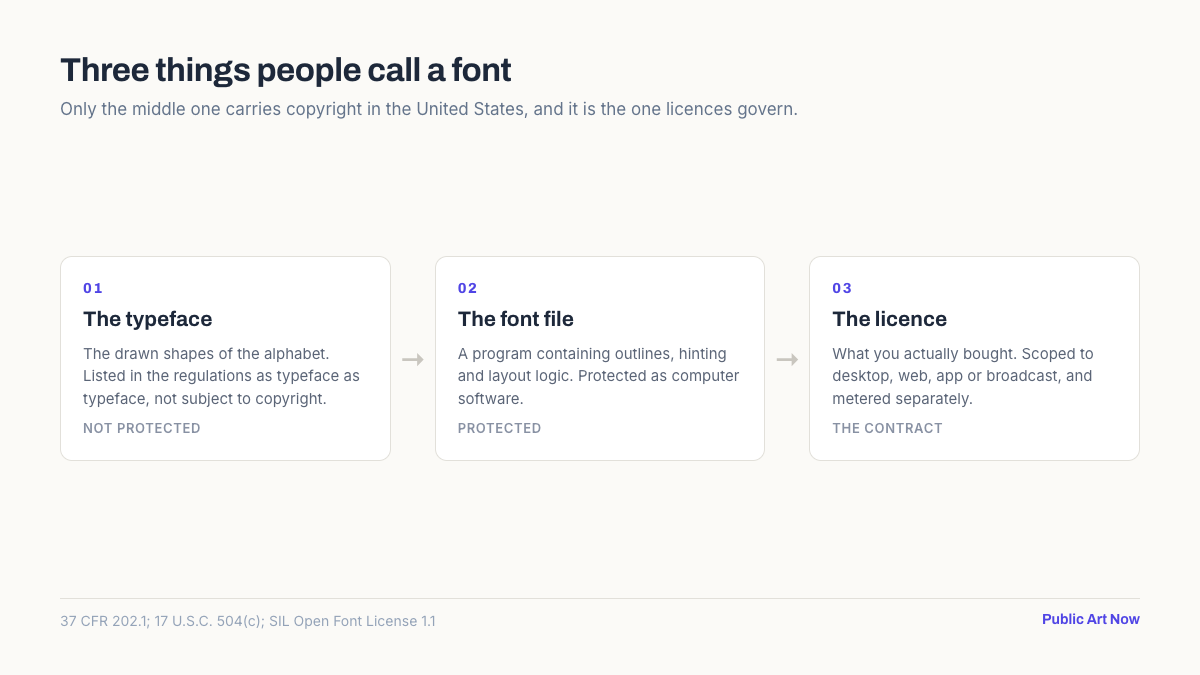
Not in the United States. 37 CFR § 202.1 lists categories of material that cannot be registered, and the list ends with a flat statement: “Typeface as typeface.” The drawn shapes of the alphabet are treated as useful articles, not as protected expression.
The font file is a different matter. A modern font is a program containing outlines, hinting instructions and layout logic, and it is protected as computer software. That is what a licence licenses and what an infringement claim attaches to.
Two consequences follow, and both surprise people. Redrawing a typeface’s shapes from scratch is generally lawful in the US, which is why so many near-identical clones exist. Copying the file is not, even where the design itself is old and freely imitated.
American law protects the file, not the letterforms. Every practical rule about font licensing follows from that one line in the regulations.
Other jurisdictions differ. The Vienna Agreement era left several European countries protecting typeface designs directly, and the UK’s design and copyright regime treats typefaces more generously than the US does. A design lawful to clone in one market may not be in another.
Which use is the licence actually covering?
Almost always a specific one, and the trouble comes from assuming a purchase covers everything. Commercial font licences are sold per use case, covering desktop, web, application, e-book or broadcast, and each is priced and counted separately, often against seat numbers or monthly page views.
| Licence type | What it covers | Common metering |
|---|---|---|
| Desktop | Installing the file to set type in design software | Number of workstations |
| Web | Serving the font to browsers via CSS | Monthly page views or domains |
| App | Embedding the font inside software | Per title or per install band |
| Broadcast | Titles and motion graphics | Per production or per term |
Type foundries publish these tiers openly, and Monotype’s end-user agreements are a representative example, so the scope is checkable before purchase. The other frequent breach is redistribution. Handing the font file to a printer, a freelancer or a client is a transfer of software, and most licences either prohibit it outright or require the recipient to hold their own licence.
How are unlicensed fonts found?
Mostly by automated inspection of published material. Web fonts are served as files with identifiable names and metadata, so a crawler can list every foundry font on a domain without human effort. PDFs embed the font with its name intact, which makes print work equally visible.
Identifying a typeface from an image is also routine now. Services such as WhatTheFont match letterforms from a photograph, so a logo on a shopfront is enough to start an enquiry.
The usual discovery moment is a rebrand or a funding round, when a company’s design work becomes visible and its ability to pay becomes obvious at the same time.
Which fonts can be used without worrying?
Fonts released under a genuine open licence, read once and then trusted. The SIL Open Font License grants permission “to use, study, copy, merge, embed, modify, redistribute, and sell modified and unmodified copies” of the font software, free of charge, subject to a few conditions.
- Documents are unaffected. The licence’s restrictions do not apply “to any document created using the Font Software”, so a PDF with the font embedded is yours.
- The font may not be sold alone. Neither the software “nor any of its individual components” may be sold by itself, though it can be bundled with other software.
- Reserved Font Names. A modified version cannot keep the original name without written permission from the copyright holder.
- Logos are fine. Setting a wordmark in an OFL font and trademarking the result is permitted; the trademark covers your mark, not the typeface.
The catch is that free download sites are full of commercial fonts relabelled as free, and a file’s origin is not visible once it is installed. Downloading from Google Fonts or a foundry’s own site is the difference between a defensible position and an undocumented one.
What is worth doing now?
Building a record before anyone asks for one. The expensive part of a font claim is rarely the licence fee; it is being unable to prove which fonts are in use, where they came from and what was paid, months or years after the design work was done.
- List the fonts actually used across the site, documents and apps, not the ones the brand guidelines name.
- Keep the receipt and the licence PDF for every commercial font, filed with the project.
- Check that the licence type matches the use, particularly desktop versus web.
- Replace anything of unknown origin with an open-licensed equivalent rather than hoping.
The same documentation habit that protects a font library also protects generated artwork, where the tool’s own licence decides commercial rights and nobody remembers which tool made which file a year later. Agencies and contractors are the weak point in almost every audit, because files travel with handovers and licences do not. Making the licence position part of the deliverable removes the problem at source.
The bottom line
The letterforms are not protected in the US; the font file is, as software. Using it outside the licence is copyright infringement with statutory damages from $750 to $30,000 per work, rising to $150,000 for wilful infringement, and detection is largely automated.
Rights admin of this kind is the unglamorous half of design work, and it applies just as much to images of artwork and public installations as it does to type. For most projects the sensible answer is an open-licensed family, downloaded from source and documented. Where a commercial face is genuinely needed, buy the licence that matches the use rather than the cheapest one available.
Frequently asked questions
What happens if you use a font without a licence?
Typically a demand letter asking for proof of licence or payment for a retroactive one. If ignored, the foundry can sue for copyright infringement of the font software, with statutory damages between $750 and $30,000 per work.
Are typefaces protected by copyright?
Not in the United States. Copyright Office regulations list “typeface as typeface” among material not subject to copyright. The font file is protected separately as computer software, which is what licences and infringement claims actually concern.
Can a desktop font licence be used on a website?
Usually not. Desktop licences cover installing the file to set type in design software. Serving the font to browsers requires a separate web licence, commonly metered by page views or domains, and this mismatch causes most claims.
Are Google Fonts safe for commercial work?
The families distributed there are released under open licences, predominantly the SIL Open Font License, which permits commercial use, embedding and modification. Download from the official source so the licence provenance is documented.
Can an OFL font be used in a logo?
Yes. The licence does not restrict documents or designs made with the font, and a wordmark set in an OFL typeface can be trademarked. The trademark protects your mark, not the underlying letterforms.