Most public art is paid for by construction budgets rather than arts budgets. A percent-for-art rule takes a small slice of the cost of a new building or road, typically about one per cent, and diverts it to artwork. The money is capital spending, which is why public art survives arts funding cuts that close galleries.
Who actually pays for public art?
Whoever is paying for the construction project the artwork is attached to. Under a percent-for-art ordinance, a fixed share of a capital project’s budget is set aside for art at the point the project is approved. For a publicly funded building that is the taxpayer; for a private development it is the developer.
This is a different pot from the one that funds museums, theatres and grants. Those come from annual operating budgets, which are contested every year and which bodies such as the National Endowment for the Arts distribute by application. Capital budgets are approved per project and are far harder to raid.
The practical effect is that a city can be cutting its arts grants and commissioning new public sculpture in the same year, which looks like incoherence and is in fact two unrelated accounting lines.
How does a percent-for-art ordinance work?
It writes the set-aside into law so it does not depend on goodwill. The ordinance names a percentage of eligible capital project costs, defines which projects qualify by type and value, and directs the money to a commissioning process run by an arts commission or public art programme. Chicago’s programme is one of the longest running, and its ordinance sets the figure at 1.33 per cent of construction or renovation cost.
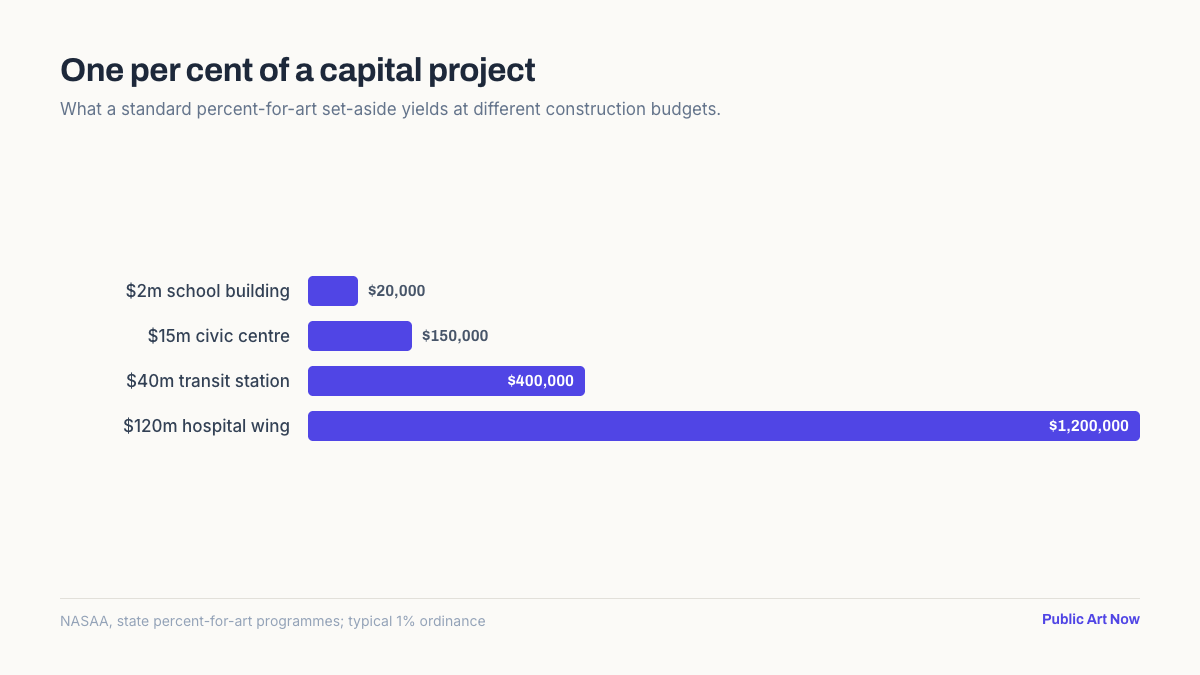
The percentage is small and remarkably consistent. The National Assembly of State Arts Agencies records that percent-for-art programmes are active in 27 states and territories, with most allocating around one per cent of capital construction costs.
Variation is at the edges rather than the centre. Florida’s programme runs up to 0.5 per cent and New Jersey’s up to 1.5 per cent, while several states impose hard caps, with New Mexico at $200,000 per project and Maine at $50,000 for school projects.
| Mechanism | Who pays | What triggers it |
|---|---|---|
| Public percent-for-art | The public capital budget | A qualifying government construction project |
| Private percent-for-art | The developer | Planning approval, often for density or height |
| In-lieu fee | The developer | A payment instead of commissioning on site |
| Grant or philanthropy | A foundation or donor | An application, usually project by project |
How long has this been the funding model?
Since the mid-1970s at state level in the United States, and longer in individual cities, as Philadelphia’s percent-for-art scheme dates from 1959. Washington established the earliest state programme in 1974, with Alaska and Oregon following in 1975. The model spread because it solved a political problem rather than an artistic one.
That problem was predictability. Commissioning artwork from an annual budget means competing with every other line item each year, and losing most of them. Attaching it to construction converts an argument about priorities into a fixed cost inside a project nobody is arguing about.
Percent-for-art works because one per cent of a bridge is invisible on the bridge’s balance sheet and transformative on the art’s.
Why do developers agree to pay?
Because they usually get something in return. Private-sector percent-for-art policies are typically negotiated as part of planning approval, with the artwork traded against height, density or a faster route through the process. The developer treats it as a cost of consent rather than as patronage.
The Americans for the Arts policy database tracks which jurisdictions apply the requirement to private development and on what terms. Many schemes also permit an in-lieu payment into a central fund instead of commissioning on site. That is often the better outcome for the art, because it pools small sums into commissions large enough to be worth an artist’s time and puts them where people actually gather.
It is also where the model is weakest. A developer indifferent to art will choose the cheapest compliant object, and the plaza sculpture that nobody looks at is usually the product of a box being ticked rather than a commission being pursued.
What does the money actually cover?
Considerably less of it reaches the artist than the headline figure suggests. A commission budget has to absorb design, engineering, fabrication, transport, installation, insurance and site works, and on a large permanent piece the structural engineering alone can exceed the artist’s fee.
- Design and artist fee. Frequently the smallest line on a large permanent commission.
- Engineering and permits. Anything structural, elevated or electrified needs certified engineering and sign-off against the local building code.
- Fabrication and installation. Cranes, road closures and specialist contractors.
- Maintenance. Often unfunded, and the main reason older works are removed rather than repaired.
Conservation bodies such as the American Institute for Conservation have argued for decades that commissioning budgets should carry an endowment for upkeep, and they rarely do. Maintenance is the structural flaw in the model. Percent-for-art funds creation, because it is tied to a construction event, and construction events do not recur. A twenty-year-old sculpture needing conservation has no percentage attached to it.
What does this mean for what gets built?
The funding shape favours durable objects in new developments, a pattern the Project for Public Spaces has documented across dozens of city programmes. Because the money arrives with a building, the artwork tends to be permanent, sited where construction is happening, and specified early enough to survive value engineering. Temporary and participatory work fits the mechanism poorly.
Because the artwork is specified alongside the building, it also tends to be designed for how the finished site will be photographed, which is a large part of why public art is now shaped for the camera first. It also explains the geography. Public art clusters where capital spending clusters, which means new transit lines, civic buildings and redeveloped waterfronts rather than the neighbourhoods with the least investment.
Programmes that want something different generally have to build a separate route for it, which is why temporary festivals and projection-based city programming sit under events budgets rather than percent-for-art.
The bottom line
Public art is mostly funded as a rounding error on construction. Around one per cent of a qualifying capital project, mandated by ordinance in 27 US states and territories and in many cities worldwide, is what pays for the sculpture outside a new civic building.
That mechanism is why the work is durable, why it appears where new building is happening, and why so little of it is maintained. Reading a piece of public art as the output of a construction budget explains most of what is otherwise puzzling about it.
Frequently asked questions
Who pays for public art?
Usually the capital budget of the construction project it is attached to. Percent-for-art ordinances divert a set share of eligible project costs into artwork, so the payer is the taxpayer for public projects and the developer for private ones.
What is a percent-for-art ordinance?
A law requiring that a fixed percentage of qualifying capital construction costs be spent on public art. Most set the figure at about one per cent, and the money is administered by a public art programme rather than by the project’s builder.
How many US states have percent-for-art programmes?
Twenty-seven states and territories, according to the National Assembly of State Arts Agencies. Washington created the first in 1974, followed by Alaska and Oregon in 1975. Many cities and counties run their own alongside the state scheme.
Do artists keep the full commission budget?
No. The budget covers engineering, fabrication, transport, installation, permits and insurance as well as the artist’s fee. On large permanent works the fee is often one of the smaller lines in the total.
Who pays to maintain public art?
Frequently nobody, which is the model’s main weakness. Percent-for-art money is tied to a one-off construction event, so unless a programme sets up a separate conservation fund, ageing works compete for ordinary maintenance budgets and often lose.