Anish Kapoor’s Cloud Gate arrived in Chicago’s Millennium Park with a polished stainless steel skin and no seams. Critics wrote about its relationship to the skyline. Visitors did something the reviews barely anticipated: they turned their backs to it, held up a camera, and photographed themselves inside the reflection. Within a few years the sculpture had a nickname, a queue, and a second life as the most reproduced image in the city. The art world called it a landmark. Everyone else called it the Bean and posted it.
That gap between what a work was designed to do and what people actually did with it has now closed. Public art commissioned today assumes the camera from the first sketch. The question is not whether that is good or bad, but what it quietly changed about which proposals get funded and which ones stopped being made at all.
The camera became the real audience
Public art has always had two audiences: the person standing in front of it and everyone they tell about it afterwards. For most of history the second audience was tiny and slow. Someone described a statue to a friend, or sent a postcard, and the work reached a few dozen more people over a year. The person physically present was the one who mattered, and sculptors designed accordingly.
Instagram inverted the ratio. A piece in a busy square might be seen by a few thousand people in a day and photographed by a few hundred, each of whom shows it to several hundred more. The remote audience is now larger than the physical one by orders of magnitude, and it arrives through a rectangular frame held at arm’s length. Once that became true, the frame started dictating the work.
Antony Gormley’s Angel of the North is a useful counterexample because it predates the shift. It was built to be read at speed from the A1 motorway, a silhouette resolving against the sky over several seconds of approach. It photographs adequately, but the experience it was engineered for cannot fit in a phone screen. Very little commissioned now is designed against a viewing condition that specific and that uncamera-like.
Scale and surface changed to suit the lens
The clearest evidence is physical. Camera-first work tends to share a set of properties, and they are properties that solve photographic problems rather than sculptural ones.
- Reflective or saturated surfaces. Mirror finishes and high-chroma colour survive compression and small screens. Muted stone does not.
- Human-scale framing. The work is sized so a person and the whole piece fit in one shot. Anything requiring a wide lens or a long walk loses.
- A designated standing position. Colette Miller’s Global Angel Wings Project, painted on walls from Los Angeles outward, is the purest version: the art is incomplete until a person stands in the gap.
- Interior or enclosing form. Yayoi Kusama’s Infinity Mirror Rooms put the viewer inside the work, which produces an image nobody can take anywhere else.
None of these are new sculptural ideas. Reflection, immersion, and viewer participation all long predate social media. What is new is that they went from being one option among many to being the default brief, because they are the properties that make a photograph worth posting.
Cities started counting reach instead of footfall
The artistic shift followed a budgetary one. A council commissioning permanent work has always had to justify the spend, and the traditional justification was local: residents get a better square, visitors stay longer, the area feels cared for. Those benefits are real but almost impossible to measure, which makes them weak arguments in a budget meeting.
Social reach is measurable. A geotag produces a count. A hashtag produces a count. Tourism boards can point at a number and attribute it to a specific commission, which is a far more comfortable position than defending a sculpture on aesthetic grounds to a sceptical finance committee. The moment that number entered the evaluation, it started shaping the brief that went out to artists.
This is the same economic logic that drove the spread of light festivals, where the after-dark timing and endlessly photographable output made the format an easy sell to city governments. Projection mapping and camera-first sculpture are two answers to one question: what public art can a city defend with a spreadsheet?
The work that photographs badly stopped getting made
Selection pressure does not announce itself. No committee has ever rejected a proposal for being unphotogenic. What happens instead is that the photogenic proposal has an extra argument in its favour, and over enough decisions that advantage compounds into a monoculture.
Nothing was banned. A whole category of work simply stopped winning, and after a decade of not winning, artists stopped proposing it.
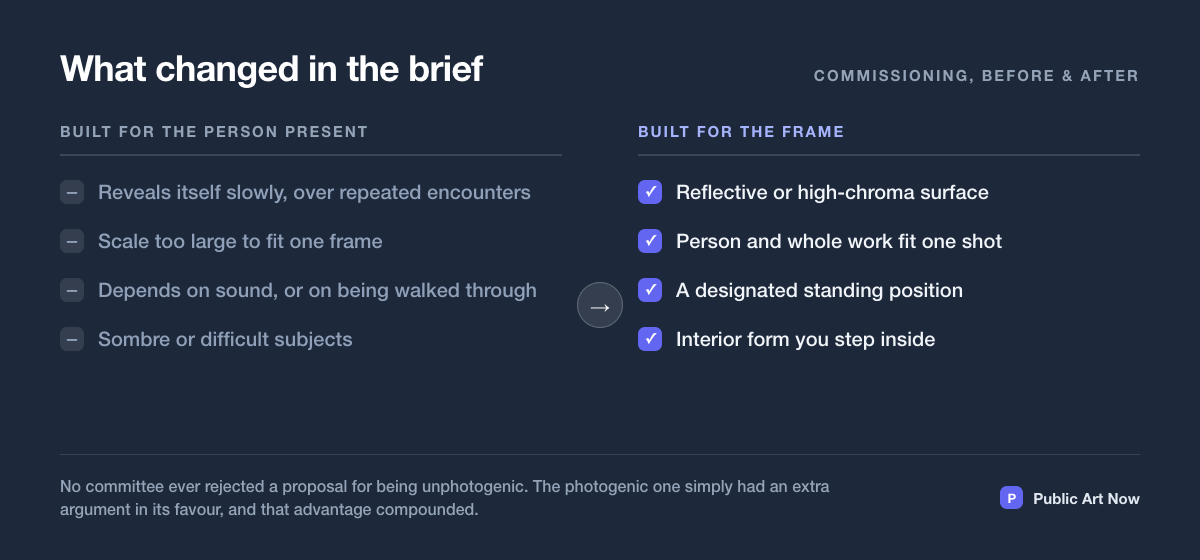
The categories that lose are specific. Work that reveals itself slowly, over repeated encounters on a daily commute, cannot demonstrate value in a single frame. Work that depends on scale too large to photograph, or on sound, or on being walked through rather than looked at, arrives at the committee with a weaker case. Difficult or sombre work fares worst of all, because the implicit test is whether someone would want to stand next to it smiling.
Memorials are the sharpest illustration. A memorial that succeeds photographically risks failing at its actual job, and the tension between those two demands is now a live problem in almost every commissioning process for difficult public history.
The criticisms worth taking seriously
The strongest objection is sameness. When every city optimises for the same medium, the outputs converge, and a reflective curved surface in one city is hard to distinguish from one three hundred miles away. Distinctiveness was the entire point of commissioning locally, and optimising for a global platform quietly undermines it.
There is also a queue problem. Random International’s Rain Room and Kusama’s mirror rooms both became known as much for waiting times as for the work, with visitors sometimes granted less than a minute inside after hours in line. When the encounter is compressed to the length of a photograph, it is fair to ask whether the photograph has replaced the encounter rather than recorded it.
The defence is not weak, though. Camera-first work has pulled people into public art who would never enter a gallery, and a piece that a thousand strangers photograph is doing something a beloved-but-ignored bronze is not. Accessibility and depth have always traded against each other in public work. The camera just moved the dial hard in one direction.
Where it goes next
Two forces are pulling against each other. The first is saturation: once every city has its reflective centrepiece, the format stops generating the reach that justified it, and the argument that won the budget starts to fail on its own terms. Novelty was doing more work than anyone admitted.
The second is that the frame itself is moving. Vertical video rewards different properties than the square photograph did, favouring motion, depth, and work you move through rather than stand before. Whatever the dominant camera format becomes, commissioning will follow it, because the underlying mechanism has not changed.
Public art has always been shaped by how it gets transmitted, and the format of the day leaves fingerprints on the work.
| Era | How the work travelled | What that rewarded |
|---|---|---|
| Cathedral facade | Seen in person, described aloud | Legible narrative, readable at a distance |
| Civic bronze | Postcards, civic record | Permanence and authority |
| Motorway landmark | Glimpsed at speed | Silhouette, scale, instant recognition |
| Camera-first sculpture | Photographed, then shared | Reflection, colour, a place to stand |
Cathedral facades were designed for people who could not read, civic bronze for an era that believed in permanent authority. The camera-first sculpture is not a corruption of that tradition. It is the same tradition, responding to the fact that the most common way to encounter public art is now a picture of someone else standing in front of it.
Frequently asked questions
What does camera-first public art mean?
It means work designed on the assumption that most people will encounter it as a photograph rather than in person. In practice that pushes commissions toward reflective or saturated surfaces, human-scale framing, and a clear place for a viewer to stand.
Why do cities commission it?
Because social reach is measurable and civic benefit is not. A geotag produces a number a finance committee can act on, which is a far easier case to make than defending a sculpture on aesthetic grounds.
What kind of work loses out?
Work that reveals itself slowly over repeated encounters, work too large to photograph, work depending on sound or on being walked through, and sombre or difficult subjects. None of it is banned; it simply arrives at the committee with a weaker case.
Is this bad for public art?
Not straightforwardly. Camera-first work has pulled in people who would never enter a gallery, and reach is a real form of access. The cost is convergence: when every city optimises for the same medium, the outputs start to look alike.
What comes after the photograph?
Vertical video rewards different properties than the square photograph did, favouring motion, depth, and work you move through rather than stand before. Commissioning will follow whatever the dominant format becomes, because the underlying mechanism has not changed.